HISTORY
During WW2 Maisemore was taken over by the Searle Aircraft Sheet
Metalwork Company, originally a London-based company. It had
come to Emsworth to set up a satellite plant in the former
Riding School's covered indoor building to escape bomb damage in
the capital. George Gray, who had earlier run his small
engineering company from Pinedemonium on Bridgefoot Path, was
seconded as an engineer to the aircraft industry and sent to
Maisemore at the outbreak of WW2. During the war the company had
about 40 staff who made vital parts for the 4-engined Stirling
bombers, fuel tanks for training aircraft and ammunition boxes.
At the end of the war the factory closed and relocated to
Newgate Lane, Fareham and is now the Searle Manufacturing
Company.
After the war the area lapsed again into poor quality farmland
occupied, according to the 1956 Kelly's entry, by R. J. Beal,
Growers Services (Emsworth Ltd.), Spraying Contractors,
Maisemore Farm, until in April 1960 Havant Borough Council
sanctioned its use for residential development and a scheme was
put forward by Tonrin Developments, their first build. The area
by the water's edge was to have no houses and would be a leisure
area for residents with seating and trees and possibly a
swimming pool, but after the initial groundwork and receiving
detailed planning permission, this original plan was revised.
Because of the sloping nature of the ground it was necessary to
raise the level of the ground from the Green southwards and many
trucks loaded with builders' rubble were tipping for a long
time, even after the first householders had taken up residence
at Easter 1962. An early Maisemore resident remembers a group of
outbuildings being demolished to the north of the estate whilst
the first houses were being built. The retaining wall at the top
of the beach is an indication of the extent to which the ground
was raised; at high water it flooded to a point about halfway up
to the present Green.
Whitehead & Whitehead advertised the estate in the following
terms:
`Houses of distinction in a landscape of beauty. The developers
have formed a Residents' Association so that the owners of the
properties in Maisemore Gardens can maintain the gardens and the
estate as a whole to a high standard.
The properties will be sold on 999-year leases at ground rents
of only 25s. per annum, and the freehold of the properties will
be owned by the Association. The Association will consist only
of the residents of MG and each resident will have a share in
it. The ground rent payable will be at the discretion of the
Association in the upkeep and administration of the communal
grounds, dinghy park and the estate as a whole. By selling
the properties in this manner the Developers have given each
resident, in common with his neighbours, the control and
ownership of the communal grounds and thus the tenure of the
properties had advantages which many freeholders do not enjoy'.
The first houses sold fast. The four-bedroomed units were a
rarity in 1962. There were also three-bedroom and detached
houses with a well-designed layout, central heating, dishwashers
and waste-disposers.
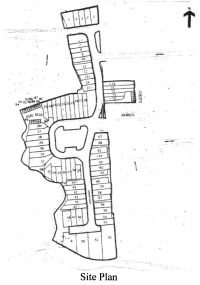
The houses were constructed in terrace groups starting with nos.
11-15 (12 being the show house), and then nos. 1-5, followed by
nos.70-74 and nos. 6-10. It seems that the general progression
was then towards the shore beginning from the north side of the
Green. By November 1964 the residents got involved and to this
day the Maisemore Gardens estate is, uniquely within this area,
under the control of its own Council of Management.
Geoff Higgins, Linda Newell, Judy Reay & Margaret Rogers 2014
NB. Copies of the original Maisemore Gardens plans and prices
for the 4-bedroomed house with integral garage (Type 'C') and
the 3-bedroomed house with integral garage (Type 'B') and
separate garage (Type `E') are in the Museum: http://www.emsworthmuseum.org.uk
An A4 booklet published in May 2015; Maisemore Gardens, the Early Years, how Maisemore Gardens Ltd came into being from 1962 to 1968
(PAGE FOOT)
FOOT)
|
Copyright © 2026 Maisemore Gardens Ltd All Rights Reserved.
Website Design: Emsworth
Online |